
How Invisalign works, start to finish
If you’re weighing up clear aligners, the first thing worth understanding is how Invisalign actually works: a series of custom-made clear aligners move your teeth in small, planned steps until they reach the position mapped out at the start. You wear each set for a couple of weeks, then swap to the next. That’s the whole idea, and the rest of this page is the detail underneath it, explained the way we’d explain it to you in the chair at Hygge Dental.
We’ve written this because so much of what’s online is either a sales pitch or a scare story. Here’s the plain version.
What is Invisalign?
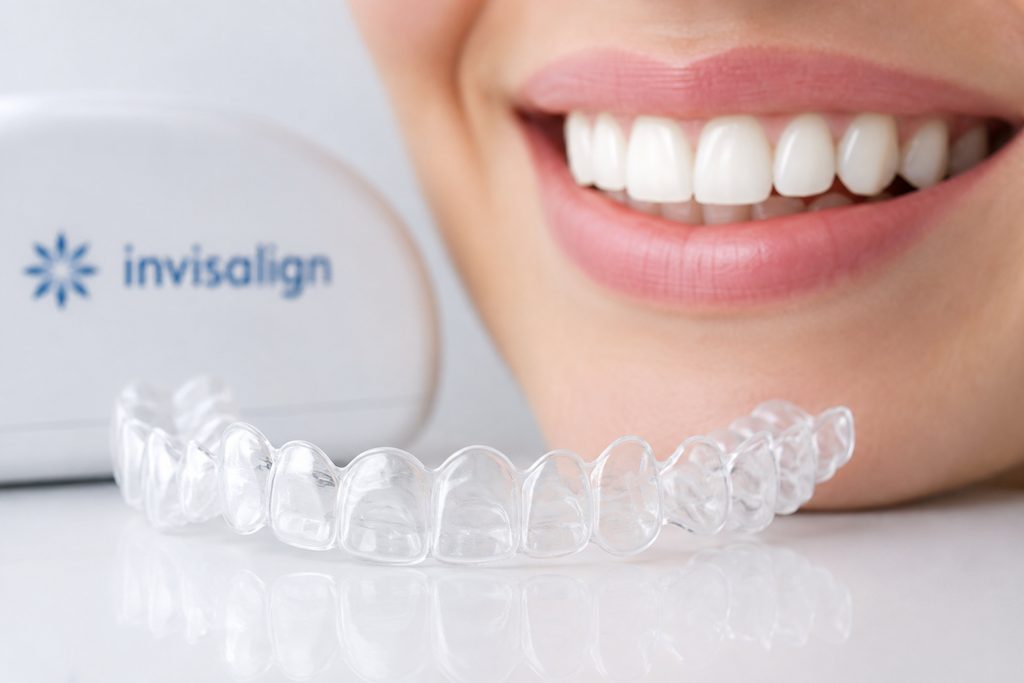
Invisalign is a clear aligner system that straightens teeth using a sequence of custom, removable trays instead of fixed metal braces. Each aligner is made from a material called SmartTrack, a flexible medical-grade plastic engineered specifically for moving teeth.
It’s worth being precise about one thing, because a lot of pages blur it. Invisalign is a brand of clear aligner, not a category. There are other aligner systems, and there are mail-order versions posted to your home. What you’re really choosing between isn’t brand A versus brand B. It’s treatment that a dentist plans and supervises versus a product you fit yourself.
How does Invisalign move your teeth?
Each aligner is shaped slightly differently from the last, so when you put it in, it doesn’t quite match where your teeth currently sit. That mismatch applies gentle, steady pressure, and over the days you wear that tray, your teeth drift into the aligner’s shape. The manufacturer designed SmartTrack to hold a more constant force over the two weeks you wear each set, which is what keeps the movement on track rather than fading after the first day or two.
Teeth don’t just slide, though. The pressure triggers the bone around each root to remodel, dissolving on one side and rebuilding on the other, so the tooth settles into its new spot and stays there. That’s a biological process, not a mechanical one, and it’s the reason wear time matters as much as it does.
What are Invisalign attachments and why might you need them?
Attachments are small tooth-coloured bumps bonded to some of your teeth, giving the aligners something firmer to grip and push against. Align describes them as small tooth-coloured shapes that act like handles for the aligners, and not everyone needs them.
Some movements, like rotating a round tooth or lifting one up or down, are hard for a smooth tray to grip on its own. Attachments make those movements possible. Whether you need them, where they go and what shape they are is a planning decision, and it’s one of the places clinical judgement earns its keep.
This is the part ten years in practice changes. Early on, you plan the movement and trust the software to deliver it. With time, you get better at reading a mouth before treatment starts: how the teeth actually need to move, whether aligners can realistically get there, and where the plan will struggle. I can usually tell at the planning stage when a case will need attachments to grip a stubborn tooth, elastics to correct a bite, or a round of refinements at the end to finish properly. And I can tell when Invisalign isn’t the right tool at all, when a case is better treated with braces. Saying that up front is part of the job. A plan that looks tidy on screen but can’t reach the result it promises helps no one.
How long does Invisalign take?
Most Invisalign treatment takes somewhere between six months and two years, depending on how much your teeth need to move. More complex cases, like correcting a significant overbite or heavy crowding, can run one to two years and use 30 or more aligners, while minor tidy-ups finish much sooner.
Nobody can give you an honest timeframe from a photo or a general article. It comes from a scan, a look at your bite and X-rays, and the treatment plan built from them. That’s why a consult estimate is worth far more than a number you found online.
How many hours a day do you have to wear them?
You wear Invisalign aligners 20 to 22 hours a day, taking them out only to eat, drink anything other than water, and brush. Clinical protocols point to 20 to 22 hours daily as the standard for predictable tooth movement, which leaves you roughly two hours across the whole day.
This is the part people underestimate, and it’s the single biggest factor you control. Aligners only work while they’re on your teeth. Leave them out too often and the current tray stops fitting properly, movement falls behind the plan, and you end up needing extra trays to catch up. The flip side is the appeal: they come out for a dinner or a photo, which fixed braces don’t allow.
Does Invisalign hurt?
Invisalign isn’t usually painful, but most people feel pressure or tenderness for a day or two each time they switch to a new tray. That’s the feeling of the aligner doing its job, and it settles as your teeth respond. Align’s own research on the SmartTrack material reported reductions in pain intensity and pressure compared with the older aligner material.
If a new set is genuinely uncomfortable rather than just snug, that’s worth a call, not a grit-your-teeth. Sometimes it means the previous tray needs a few more days before you move on.
Can Invisalign fix an overbite, gaps or crowding?
Invisalign can treat many common issues, including crowding, spacing and some bite problems, but not every case suits clear aligners. The honest answer for any specific mouth depends on what’s actually going on, which is why diagnosis comes before any promise. Some bites are better corrected with braces, and a good clinician will tell you that up front rather than starting a plan that can’t reach the result.
This is also where unsupervised, mail-order aligners carry real risk. The Australian Dental Association’s position is that orthodontic treatment should involve clinical assessment and ongoing monitoring by a registered dental practitioner. Skip the diagnosis and a bite problem can be made worse rather than better, sometimes without you noticing until it’s expensive to undo.
Is Invisalign better than braces?
Neither is simply better; they suit different cases and different people. Invisalign is removable, nearly invisible and often more comfortable, which matters a lot to adults who don’t want a mouth of metal. Traditional braces can be the stronger choice for complex movements and don’t rely on you remembering to keep them in.
The right call comes down to your teeth, your bite, how complex the movement is, and how disciplined you’ll be with wear time. That’s a conversation, not a coin toss.
How we approach it at Hygge Dental
At Hygge, Invisalign is treated as orthodontic design, not a product we hand over. We plan the movement with Digital Smile Design and 3D scanning before the first aligner goes in, considering your bite, your gumline and how the result sits within your face, so the plan is built around you and not just your teeth.
If you’re wondering whether clear aligners are right for your smile, the next step is a consult where we scan, assess and show you what’s actually possible. You’ll see what we see and leave understanding your options.
Book a consult or call us on (07) 3667 7002.
Written by Dr Tara Møller, Principal Dentist and Co-Founder of Hygge Dental, Spring Hill. BPharm (UQ), DDS (Melb), official Digital Smile Design provider and University of Queensland dental educator. Read Dr Tara’s full bio.
How Invisalign works, start to finish
If you’re weighing up clear aligners, the first thing worth understanding is how Invisalign actually works: a series of custom-made clear aligners move your teeth in small, planned steps until they reach the position mapped out at the start. You wear each set for a couple of weeks, then swap to the next. That’s the whole idea, and the rest of this page is the detail underneath it, explained the way we’d explain it to you in the chair at Hygge Dental.
We’ve written this because so much of what’s online is either a sales pitch or a scare story. Here’s the plain version.